Yes, you can use a telescope from a balcony, but not every balcony is a good observing site.
A workable balcony needs three things: the object you want to observe must cross the part of the sky you can see, the telescope must fit on stable floor space, and you must be able to operate everything without leaning over the railing or extending equipment beyond it.
When those conditions are met, the Moon and bright planets can make excellent first targets. If buildings block the view, footsteps keep the image shaking, warm rooftops distort the view, or the telescope cannot be operated safely, use a ground-level location instead.
Start With a Five-Minute Balcony Check
Before carrying out every accessory, stand where you plan to place the telescope and check five things.
1. Visible Sky
Continue if you can see a continuous section of sky and a sky map shows your target crossing it. Move elsewhere if you have only a narrow gap and the target stays behind walls or rooftops.
2. Operating Space
Continue if the tripod, telescope, and observer remain fully inside the railing. Move elsewhere if focusing or moving the telescope requires leaning outward.
3. Stability
Continue if the view settles quickly after you move. Move elsewhere if every step causes prolonged shaking.
4. Line of Sight
Continue if you can avoid direct lights and large, warm rooftops. Move elsewhere if a bright light shines at you or most of the view crosses heat-producing surfaces.
5. Household Safety
Continue if children can participate with continuous adult supervision. Move elsewhere if the space is crowded, cables create trip hazards, or the telescope can be knocked over.
Think of your visible sky as a sky window. You do not need an unobstructed view in every direction, but the object you want to see must pass through that window at the time you plan to observe.
Do not choose a balcony based only on whether it faces north, south, east, or west. There is no single best direction for every location, season, time, and target.

Your useful sky is the unobstructed area a target crosses at the time you plan to observe.
Plan the Target Before Placing the Tripod
Open a sky map or stargazing app that lets you set your location, date, and observing time. Check the Moon first, then see whether Jupiter, Saturn, Venus, or Mars is visible that night. Planet positions change with the season and year, so a fixed direction in an article will eventually become wrong.
Once you know where the target should appear, check that part of your balcony view. Look for upper-floor balconies, walls, trees, and nearby buildings that may block it.
A target that is hidden now may rise into view later. It may also become accessible in a different season. The useful question is not simply, “Can I see the Moon from this balcony?” It is, “When will the Moon cross the part of the sky this balcony can see?”
If you are unfamiliar with the night sky, start without the telescope. Locate the Moon or a bright planet with your eyes or binoculars. A telescope shows only a small area of sky, so searching blindly at high magnification can be frustrating.
Safe Placement Matters More Than Maximum Aperture
Place the tripod on a level, uncluttered floor. Keep every tripod leg, cable, counterweight, accessory, and possible telescope position inside the railing.
Do not place a tripod on a chair, table, storage box, or other temporary platform. Do not attach the telescope to the balcony railing.
Set up while the area is still lit, then rehearse the complete motion of an observing session. Sit or stand at the eyepiece, turn the telescope, adjust focus, change an eyepiece, and point toward both edges of your sky window. If any step requires leaning over the railing or creates a risk of dropping the telescope, phone, or eyepiece, choose a different position.
Children should participate only with continuous supervision from an adult who understands the equipment. Remove loose cables, open accessory cases, and small tables from the walking area.
Solar observing requires a separate safety rule. Never point a telescope, finder, or binoculars at the Sun unless a proper solar filter is securely installed over the full front aperture of the instrument. Small solar filters that attach at the eyepiece are unsafe. Sunglasses, camera filters, and improvised materials are not substitutes for a certified solar filter.

Use level floor space and keep the full operating area away from the railing.
Why the View Shakes or Looks Like It Is Underwater
Two common balcony problems are mechanical vibration and disturbed warm air. They can look similar, but they require different fixes.
Focus on the Moon or another bright target, then stop touching the telescope. If the image starts shaking after you walk, focus, or touch the tripod, the problem is probably mechanical vibration.
Try these adjustments:
- Retract the tripod legs instead of using their full height.
- Confirm that every clamp and lock is secure.
- Move cables that touch the tripod or telescope.
- Reduce movement while someone is looking through the eyepiece.
- Use lower magnification.
Do not hold the telescope tube to make it steady. Your hand usually introduces more movement.
If the telescope is untouched but the image keeps bending and rippling, your line of sight may be passing through unevenly heated air. Rooftops, parking lots, walls, and other surfaces release heat after sunset and can soften fine detail.
Wait for the surroundings to cool, choose a direction that does not cross a warm rooftop, or observe a target higher in the sky. High magnification enlarges the target, but it also enlarges vibration and atmospheric distortion.
Begin with your longest-focal-length eyepiece, which usually provides the lowest magnification and widest field. Increase magnification only after the target is centered, focused, and stable.
What Should You Observe First?
The Moon is usually the easiest practice target. It is bright, easy to locate, and useful for checking whether the finder, main telescope, focus, and tripod are working together.
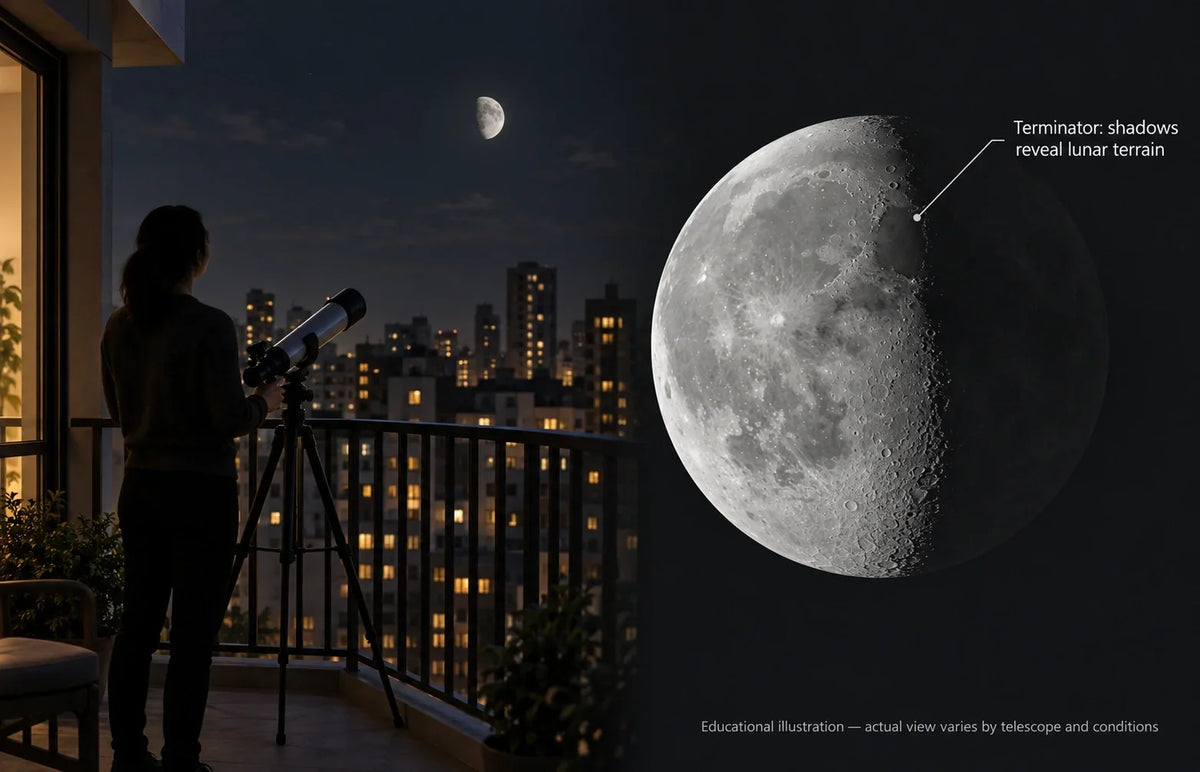
Start by finding the complete lunar disk at low magnification. Then look near the boundary between lunar day and night, called the terminator. Shadows near this boundary make craters and terrain easier to notice.

Educational illustration. The actual view varies by telescope and conditions.
Bright planets can also work well from a city balcony, but check whether they are actually in your sky window that night.
- Venus: Very bright and useful for observing its changing phases, but not surface detail.
- Jupiter: May show a bright disk and its four large Galilean moons. Visible detail depends on the telescope and conditions.
- Saturn: Under suitable conditions, its rings can appear separate from the planet, although the view remains small.
- Mars: Most rewarding near favorable observing periods; it may look like only a small orange-red disk at other times.
Nebulas, galaxies, and faint clusters are more affected by urban light pollution. Read Koolpte's guide to observing under light-polluted skies for realistic target planning.
A balcony's biggest advantage is convenience. It gives you a place to practice repeatedly. It does not replace every dark-sky observing site.
Follow This 20-Minute First-Night Plan
- Check the equipment before dark. Install the telescope and confirm that every clamp is secure. If you align the finder during the day, stay far away from the Sun.
- Confirm your sky window. Use a sky map to find when and where the Moon or a bright planet will appear.
- Clear the operating area. Remove small furniture, loose cables, and trip hazards. Keep the observer and equipment inside the railing.
- Start at low magnification. Use the longest-focal-length eyepiece. Locate the target with the finder, then focus slowly.
- Let the image settle. After touching the focus control, wait a few seconds before judging the view.
- Observe one target well. Finding and focusing on the Moon or one planet is a successful first night. You do not need a ten-object checklist.
- Pack up safely. Turn on the balcony light, replace the optical caps, count the eyepieces and phone accessories, and bring the telescope indoors.
Do not leave a telescope on a balcony as permanent outdoor furniture. Dust, moisture, rain, direct sunlight, and repeated temperature changes can damage optical, mechanical, and electronic components.
Four Quick Troubleshooting Checks
The Finder Shows the Target, but the Main Telescope Does Not
The finder may not be aligned with the main telescope. At low magnification, use a distant stationary object to align both views during the day, staying completely away from the Sun. The Moon is also a forgiving nighttime alignment target.
The View Is Only a Blurry Bright Circle
Turn the focus control slowly through the sharpest point, then reverse direction for a fine adjustment. A star should become smaller as focus improves, not expand into a larger disk. Also confirm that every lens cap is removed; some caps have a smaller center opening that can be mistaken for the full aperture.
The Image Shakes Whenever You Touch the Telescope
Lower the magnification, retract the tripod legs, check the locks, and reduce movement. If a light touch causes a long period of vibration, the current mount or floor may not support useful high-magnification observing.
The Target Looks Like It Is Boiling
Avoid looking across warm rooftops and walls. Wait for the surroundings to cool or choose a target higher in the sky. Even correctly functioning equipment cannot remove atmospheric and local heat distortion.
When Binoculars or a Ground-Level Site Are Better
Binoculars may be a better first tool when the balcony shows a broad but shallow section of sky or lacks enough room for a safely opened tripod. Their wider field makes the Moon, bright stars, and large clusters easier to locate.
If you use a binocular mount, it still needs the same level floor space and safe operating area as a telescope tripod.
Move to a ground-level observing site when an upper balcony blocks the target, every footstep causes severe vibration, or safe operation would require working too close to the railing. A permitted open area or a local astronomy club event may provide a steadier floor and a much larger sky window.
The Bottom Line
The best balcony telescope setup is not the one with the largest specification. It is the setup that fits completely inside the available space, remains stable, points into the sky you can actually see, and is simple enough to use regularly.
Confirm that your target will cross your sky window. Make sure the full setup can be operated safely inside the railing. Start with the Moon or one bright planet, use low magnification, and learn how to locate, focus, and wait for a steady view.
Once you know that your balcony works, compare telescopes based on storage space, carrying distance, preferred targets, and budget. Koolpte's city-stargazing telescope guide covers that separate buying decision.
Frequently Asked Questions
Can I use a telescope through a window?
It is usually not recommended. Window glass can degrade the view, and temperature differences or air movement around an open window can make high-magnification images unstable. Observe directly outdoors from a safe location when possible.
Which direction should a stargazing balcony face?
There is no universally best direction. Visibility depends on your location, date, time, target position, and surrounding buildings. Use a sky map to check when a target crosses the part of the sky your balcony can see.
Can I see galaxies from a city balcony?
Some of the brightest objects may be detectable under suitable conditions, but urban light pollution and a restricted view reduce what you can see. The Moon and bright planets provide a more reliable first balcony session.
Can I leave my telescope on the balcony?
It is not recommended. Dust, moisture, rain, direct sunlight, and temperature changes can affect the optics, mount, and electronics. Replace the caps and store the telescope in a clean, dry indoor location after observing.
Can I observe the Sun from a balcony?
Only when a suitable, undamaged solar filter is securely installed over the full front aperture and all manufacturer instructions are followed. Never point an unfiltered telescope, finder, or binoculars at the Sun. Children must remain under continuous adult supervision.
Share:
Using a Telescope in Cold Weather: Winter Astronomy Tips and Care Guide
Why Can't I See Anything Through My Telescope? 9 First-Night Fixes