Binoculars and telescopes are not competing versions of the same tool. Binoculars provide a wide, upright view with almost no setup. A telescope provides more magnification and makes lunar and planetary detail easier to study.
| Start with | When you want |
|---|---|
| Binoculars | Maximum portability, wide star fields, and easy sky learning |
| Telescope | Lunar detail, Jupiter's bright moons, Saturn's rings, and interchangeable magnification |
Why Binoculars Are a Serious Astronomy Tool
Binoculars let you use both eyes and see a much wider area of sky than a typical telescope view. That makes them useful for learning constellations, following star-hopping routes, and viewing large targets such as the Pleiades.
They are also easy to carry and can be used immediately. For travel or long hikes, this simplicity may matter more than magnification.
Binoculars do have limits. Hand shake becomes more noticeable at higher power, and most models do not provide enough magnification to show Saturn's rings clearly or study small lunar details the way a telescope can.

Why Start With a Telescope
A telescope is the stronger first choice when the Moon and planets are the main goal. A modest beginner telescope can show lunar craters, Jupiter's four bright Galilean moons, and Saturn's rings under suitable conditions.
Interchangeable eyepieces also let the observer begin with a wide, low-power view and then increase magnification after the target is centered. That flexibility comes with additional setup: a tripod or base, finder alignment, focusing, and manual tracking.
What You Can Realistically See
With binoculars, expect wide star fields, bright open clusters, the Moon as a complete disk, the Orion Nebula as a glow, and the Andromeda Galaxy as a faint elongated haze under suitable skies.
With a beginner telescope, expect more lunar terrain, Jupiter's moons, Saturn's rings, Venus's phases, bright clusters, and selected nebulae. Planets will still look small, and deep-sky objects will not show processed-photo color. For a closer look at the telescope side, see what a 70mm telescope can actually show.
Portability and Learning Curve
Binoculars win when the observing session needs to begin in seconds. A telescope requires more equipment but teaches focusing, finding, tracking, and changing magnification.
For families, consider who will help with setup. A child can enjoy binoculars quickly, while a telescope usually works best when an adult first aligns the finder and demonstrates low-power aiming.
The Best Long-Term Approach
Many observers eventually use both. Binoculars locate a region and reveal the surrounding star field; the telescope then examines a smaller target at higher magnification.
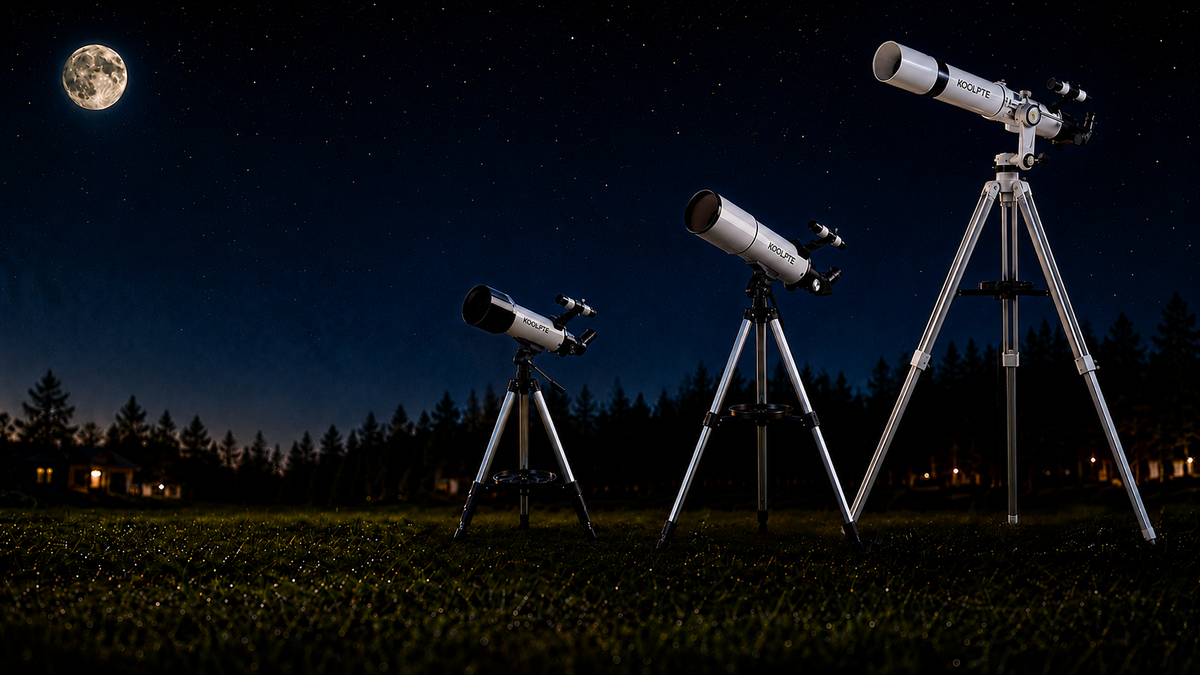
If you choose a telescope first, prioritize a stable mount and easy low-power view. The Koolpte Vega Air 70/400 is the most portable current Koolpte path. Readers who need a broader comparison can browse current beginner telescopes.
Final Recommendation
Choose binoculars first if portability, travel, and learning the sky matter most. Choose a telescope first if your main goal is lunar and planetary detail. Do not buy either tool based only on advertised magnification.
FAQ
Are binoculars good enough for astronomy?
Yes. They are especially useful for wide star fields, large clusters, the Moon, and learning the sky.
Can binoculars show Saturn's rings?
Typical handheld binoculars may show Saturn as non-stellar or slightly elongated, but a telescope is the more reliable tool for separating the rings from the planet.
Is a telescope harder to use?
It requires more setup and aiming practice, but beginning with the lowest-power eyepiece and aligning the finder during the day makes the first session easier.
Should a child start with binoculars or a telescope?
It depends on adult support and the goal. Binoculars are simpler for scanning; a stable telescope with adult help is better for detailed Moon and planet views.
Share:
Best Telescope for Moon Observation 2026: See Lunar Craters Like Never Before
Best Telescope for City Stargazing 2026: Beat Light Pollution