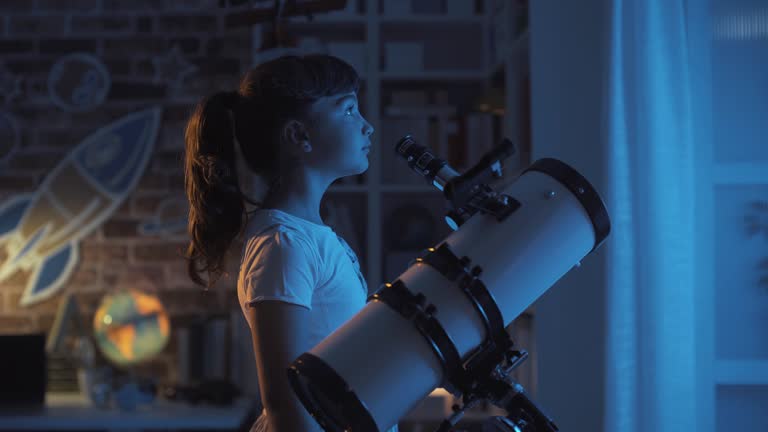
The best telescope for a child is not determined by age alone. A stable mount, reachable controls, adult support, and an easy first target matter more than a large magnification number.
What Parents Should Prioritize
- A stable mount that settles after focusing.
- A low-power eyepiece for finding the Moon.
- A finder that an adult can align during the day.
- A complete setup the family can carry and store.
- Simple instructions and realistic expectations.
Avoid toy telescopes marketed mainly with extreme power. A shaky image at high magnification is more frustrating than a clear low-power Moon view.
Adult Help Matters
Young children should not be expected to assemble, align, aim, and focus a telescope alone on the first night. An adult can prepare the tripod, align the finder, locate the Moon, and then let the child practice focusing and tracking.
Never point a telescope or finder at the Sun without a correctly fitted, purpose-built solar filter and knowledgeable supervision. An eyepiece solar filter is not safe.

Choose by Family Use, Not a Rigid Age Chart
For compact storage and travel, the Vega Air 70/400 provides a wide low-power starting point.
For a longer-focal-length 70mm starter kit, consider the Vega Lite 70/500.
An 80mm telescope can provide more collecting area, but the family should first confirm that the larger complete setup remains comfortable to move and use.
Plan the First Night
- Set up before dark.
- Align the finder on a distant stationary object.
- Start with the Moon and the longest-focal-length eyepiece.
- Keep the first session short.
- Let the child describe what they see instead of promising photo-like detail.
- Stop before cold, fatigue, or frustration takes over.
Realistic Targets
The Moon is the best first target. A suitable beginner telescope can also show Jupiter's bright moons, Saturn's rings, bright star clusters, and selected nebulae under appropriate conditions. For realistic first-night targets with a small refractor, see what a 70mm telescope can actually show.
Phone photography should begin with the Moon. Attaching a phone can make aiming harder, so achieve a clear visual view first.
FAQ
What telescope is best for a six-year-old?
A stable, simple telescope used with active adult help is more important than a specific model assignment.
Can a child use a telescope alone?
Older children may learn independent use, but initial setup and all solar safety require responsible adult supervision.
Is 70mm enough for a child?
Yes. A 70mm refractor can provide rewarding Moon and bright-planet views while remaining manageable for many families.
How long should a first session last?
Keep it short enough to finish with a successful target and continued curiosity. Ten focused minutes can be better than an hour of searching.
Share:
Best Telescope for Kids and Family Stargazing in 2026