
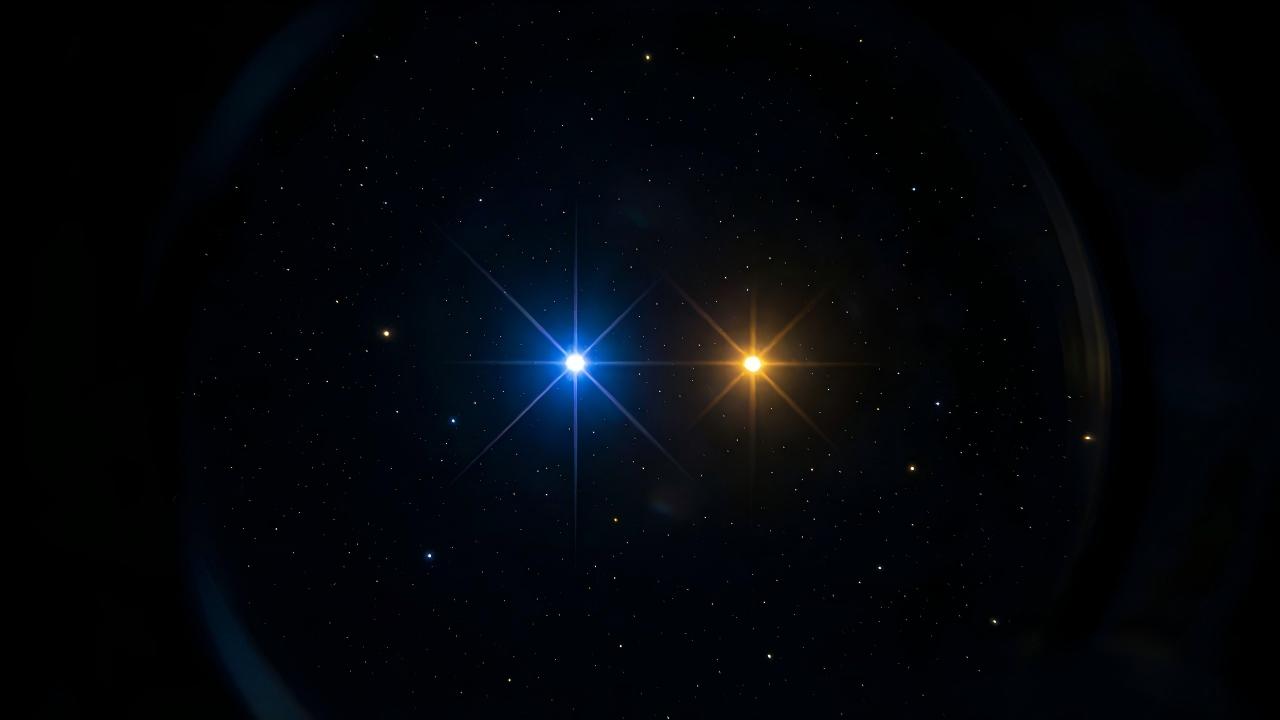
Double Star Observing Guide: Best Binary Stars to See with a Small Telescope
Double stars are the most underrated targets in amateur astronomy. Unlike nebulae and galaxies, which can be frustratingly faint from the suburbs, double stars shine brilliantly through light pollution — and some of the most beautiful color contrasts in the night sky belong to binary systems. Even a 70mm telescope can deliver dazzling views.

What Are Double Stars?
A double star is any pair of stars that appear close together in the sky. They come in two types:
| Type | Description | Also Called |
|---|---|---|
| Optical Double | Two stars that appear close by line-of-sight chance, but are at different distances | Line-of-sight pair |
| Binary (Physical Double) | Two stars gravitationally bound, orbiting a common center of mass | True binary |
Most of the famous double stars in amateur astronomy are true binaries — stars that were born together and will orbit each other for billions of years. Albireo (Beta Cygni), for example, takes roughly 100,000 years to complete one orbit.
Why Double Stars Are Perfect for Suburban Astronomers
- Visible from city/suburban skies (small angular size = less affected by light pollution)
- Require no filters or special equipment
- Color contrast is best at low-to-moderate magnification
- Good for testing telescope optical quality
- Some tight pairs require steady seeing
- Very close doubles need high magnification (which amplifies atmospheric turbulence)
- Not as "photogenic" on social media as nebulae
Best Double Stars for Small Telescopes (70mm–90mm)
| Star | Constellation | Separation | Magnitudes | Colors | Difficulty |
|---|---|---|---|---|---|
| Albireo (β Cyg) | Cygnus | 34" | 3.1 + 5.1 | Gold + Blue | Easy ★☆☆ |
| Mizar & Alcor (ζ UMa) | Ursa Major | 708" (11.8') | 2.2 + 3.9 | White + White | Very Easy ★☆☆ |
| Castor (α Gem) | Gemini | 5.4" | 1.9 + 2.9 | White + White | Moderate ★★☆ |
| Gamma Andromedae (Almach) | Andromeda | 9.8" | 2.3 + 5.0 | Orange + Blue-Green | Easy ★☆☆ |
| Epsilon Lyrae (Double Double) | Lyra | 208" + 2.3" | 4.7 + 4.7, 5.1 + 5.1 | White + White | Challenge ★★★ |
| Antares (α Sco) | Scorpius | 2.9" | 1.0 + 5.4 | Red + Green | Moderate ★★☆ |
| Algieba (γ Leo) | Leo | 4.4" | 2.4 + 3.7 | Gold + Gold | Easy ★☆☆ |
| Izar (ε Boo) | Boötes | 2.9" | 2.5 + 4.9 | Gold + Blue-Green | Moderate ★★☆ |
| Acrux (α Cru) | Crux | 4.0" | 1.3 + 1.6 | Blue + Blue | Easy (Southern) ★☆☆ |
| Porrima (γ Vir) | Virgo | 0.8–3.0" (varies) | 3.5 + 3.5 | White + White | Challenge ★★★ |
How to Split a Double Star: The Dawes Limit
The Dawes Limit gives the theoretical minimum separation (in arcseconds) that a telescope can resolve as two distinct points:
| Aperture | Dawes Limit | Example: Can It Split Castor (5.4")? |
|---|---|---|
| 50mm | 2.3" | ✅ Yes, easily |
| 70mm | 1.7" | ✅ Yes |
| 90mm | 1.3" | ✅ Yes |
| 130mm | 0.9" | ✅ Yes, and can split tighter pairs |
But there's a catch: The Dawes Limit is a theoretical best-case. In practice, atmospheric seeing often limits resolution to 1–2 arcseconds, even with a large telescope. This is why double stars with separations of 2" or more are the most satisfying targets — they split cleanly on most nights.
Recommended Eyepieces for Double Stars
Double stars are best viewed at moderate magnification (50x–100x). Too little magnification and the stars appear as one; too much and atmospheric turbulence blurs the view.
| Double Star Separation | Recommended Magnification | Example Eyepiece (90mm scope) |
|---|---|---|
| > 10" (wide pairs) | 50x–80x | 25mm–16mm |
| 3"–10" (moderate) | 80x–120x | 16mm–10mm |
| < 3" (tight pairs) | 120x–180x | 10mm–6mm or Barlow |
Albireo: The Most Beautiful Double Star
No double star guide would be complete without a spotlight on Albireo (Beta Cygni). Located at the "head" of Cygnus the Swan, Albireo is a Summer/Fall target visible from the Northern Hemisphere from June through November.
Through a moderate magnification eyepiece, Albireo reveals a brilliant golden-yellow primary star paired with a sapphire-blue companion. The color contrast is so vivid that it almost doesn't look real — and the fact that it's easily visible in a 70mm telescope makes it accessible to every amateur astronomer.
When to Observe the Best Double Stars
| Season | Best Double Stars |
|---|---|
| Winter | Castor (Gemini), Almach (Andromeda, still visible), Algieba (Leo, rising) |
| Spring | Algieba (Leo), Porrima (Virgo), Regulus (challenging, 3" separation) |
| Summer | Albireo (Cygnus), Epsilon Lyrae (Double Double), Antares (Scorpius) |
| Fall | Albireo (still up), Almach (Andromeda), Delta Cephei (variable double) |
Advanced Challenge: The "Double Double" (Epsilon Lyrae)
Epsilon Lyrae is actually four stars — two wide pairs, each of which is itself a close double. The wide pairs are separated by about 208 arcseconds (easily split at 50x), but each wide pair consists of two stars separated by only about 2.3 arcseconds.
Splitting the inner pairs requires:
- A steady night (good seeing)
- At least 90mm aperture
- 150x+ magnification
This is a great test of both your telescope's optical quality and your local seeing conditions. The Koolpte 90mm can split Epsilon Lyrae's inner pairs on nights of good atmospheric stability.
Conclusion
Double stars offer some of the most accessible and rewarding observing in amateur astronomy. They require no dark skies, no filters, and no expensive equipment — just a telescope and a clear night. Start with Albireo and Mizar-Alcor, then work your way through the list above. Each new split is a small victory, and the color contrasts will keep you coming back to the eyepiece.
Choosing your first telescope? Make sure it has at least 70mm of aperture — that's the sweet spot for resolving beautiful double star systems.
For more on telescope optics and what you can see with different apertures, read our guide to telescope resolution and the Dawes Limit.
Share:
Telescope Dew Control: How to Prevent and Remove Dew from Optics
Nebula Filters Guide: UHC, O-III, and H-Beta Filters Explained