
Nebula Filters Guide: UHC, O-III, and H-Beta Filters Explained
If you live in a city or suburb, light pollution washes out faint nebulae — making them invisible even through a good telescope. Nebula filters are the solution. These specialized optical filters block specific wavelengths of light pollution while passing the narrow emission lines of glowing gas clouds. Used correctly, they can transform a washed-out sky into a nebula-rich viewport.

How Nebula Filters Work
Nebulae emit light at very specific wavelengths — mostly hydrogen-beta (486nm), oxygen-III (496nm & 501nm), and hydrogen-alpha (656nm). These are emission lines — the nebula glows at these precise colors because the gas is excited by hot nearby stars.
Light pollution, on the other hand, is broad-spectrum — it emits across the entire visible range (and beyond). A nebula filter works by blocking the broad spectrum (light pollution) while passing the narrow emission lines (nebula). The result: the background sky gets darker, and the nebula stands out in higher contrast.
The Three Main Types of Nebula Filters
| Filter Type | Bandpass Width | Best For | Bandpass (nm) |
|---|---|---|---|
| UHC (Ultra High Contrast) | Medium-wide (~24nm) | Most emission nebulae; general purpose | ~480–504nm |
| O-III (Oxygen-III) | Narrow (~12–15nm) | Planetary nebulae, supernova remnants | ~496 & 501nm only |
| H-Beta (Hydrogen-Beta) | Very narrow (~9–12nm) | Specific Hβ nebulae (Horsehead, California) | ~486nm only |
UHC Filters: The Best All-Around Choice
UHC (Ultra High Contrast) filters pass the two oxygen-III lines (496nm, 501nm) and the hydrogen-beta line (486nm), while blocking everything else. This makes them ideal for most emission nebulae, which glow strongly in these wavelengths.
What UHC Filters Reveal
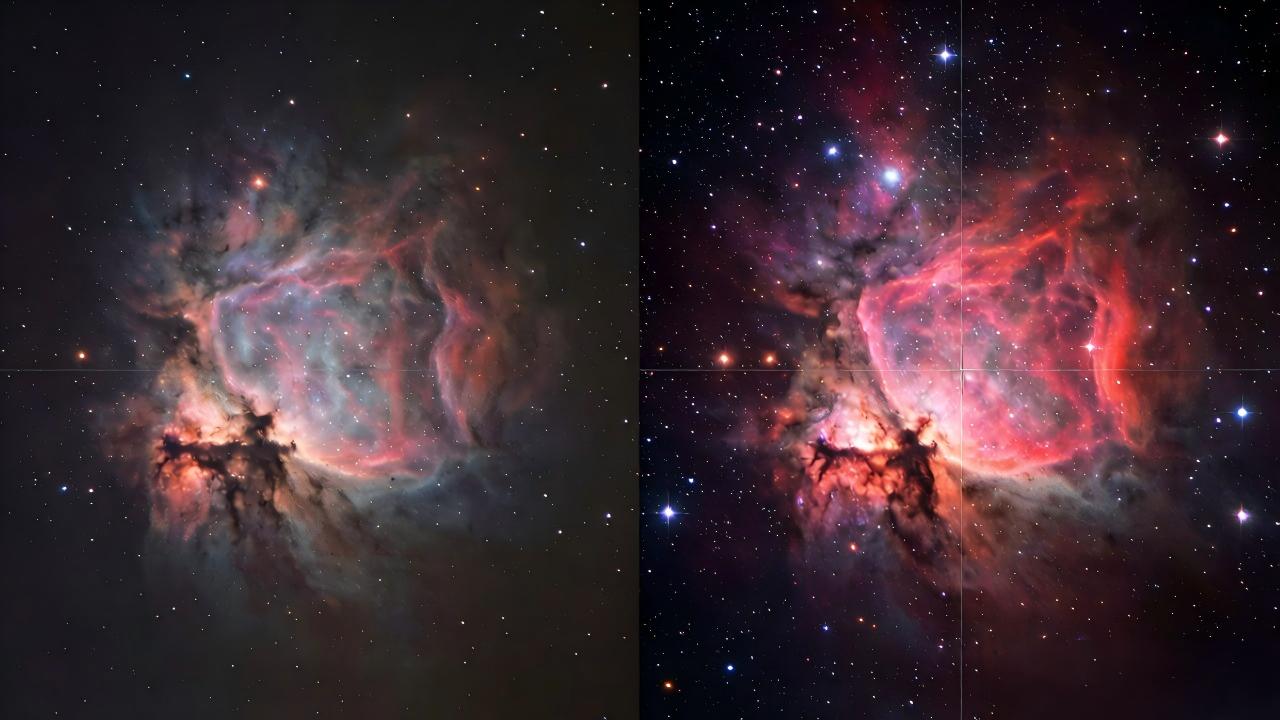
- Orion Nebula (M42) — dramatic contrast boost
- Lagoon Nebula (M8)
- Trifid Nebula (M20)
- Eagle Nebula (M16)
- All emission nebulae in Sagittarius/Scutum
- Reflection nebulae (pleiades nebula — no emission lines)
- Galaxies (starlight, not emission)
- Star clusters (point sources)
- Hα-only nebulae from heavily light-polluted sites
O-III Filters: For the Toughest Targets
O-III (Oxygen-III) filters are narrower than UHC — they pass only the two oxygen emission lines (496nm and 501nm). This makes them more aggressive at cutting light pollution, but also dimmer overall. O-III filters are the secret weapon for:
| Target Type | Examples | Why O-III Works |
|---|---|---|
| Planetary Nebulae | M57 (Ring Nebula), M27 (Dumbbell) | These are hot O-III emitters; filter makes them "pop" |
| Supernova Remnants | Veil Nebula (Cygnus Loop) | Filamentary structure glows in O-III |
| Some Emission Nebulae | North America Nebula | Also visible with UHC, but O-III can help from cities |
Warning: O-III filters dim the view significantly. They work best with apertures of 90mm and larger — a 70mm telescope may not gather enough light to make the filtered view worthwhile.
H-Beta Filters: The Specialist's Choice
H-Beta (Hydrogen-Beta) filters are the narrowest and most specialized. They pass only the hydrogen-beta line at 486nm. Very few nebulae are strong Hβ emitters, but the ones that are become visible ONLY with this filter.
The two famous Hβ targets:
- Horsehead Nebula (B33): Invisible without Hβ from most sites; the filter darkens the background and makes the dark horsehead shape visible against the dim glow of IC 434
- California Nebula (NGC 1499): A large, faint emission nebula in Perseus; Hβ helps reveal its structure
Which Filter for Which Nebula? (Reference Table)
| Nebula | Type | UHC | O-III | H-Beta |
|---|---|---|---|---|
| Orion Nebula (M42) | Emission | ★★★★★ | ★★★★☆ | ★☆☆☆☆ |
| Ring Nebula (M57) | Planetary | ★★★★☆ | ★★★★★ | ★☆☆☆☆ |
| Dumbbell Nebula (M27) | Planetary | ★★★★☆ | ★★★★★ | ★☆☆☆☆ |
| Veil Nebula | Supernova Remnant | ★★★★☆ | ★★★★★ | ★★☆☆☆ |
| Horsehead Nebula (B33) | Dark + Emission | ★★☆☆☆ | ★★☆☆☆ | ★★★★★ |
| Lagoon Nebula (M8) | Emission | ★★★★★ | ★★★☆☆ | ★★☆☆☆ |
| Eagle Nebula (M16) | Emission | ★★★★★ | ★★★☆☆ | ★★☆☆☆ |
| Pleiades (M45) | Reflection | ★☆☆☆☆ | ★☆☆☆☆ | ★☆☆☆☆ |
How to Use Nebula Filters
Nebula filters screw into the bottom thread of your eyepiece (the side that goes into the focuser). They're strictly visual-use only — don't use them for photography (you need different filters for astrophotography).
Step-by-Step Filter Use
- Screw the filter into your eyepiece before inserting into the telescope
- Start with your widest-field eyepiece (lowest magnification) — this gives the brightest view
- Compare the view with and without the filter by simply unscrewing the eyepiece and removing the filter
- If the filter improves contrast without making the nebula too dim, keep it in
City vs. Dark Sky: Does Filter Choice Change?
| Observing Site | Best Filter Strategy | Why |
|---|---|---|
| City (Bortle 8–9) | UHC is essential; O-III helps for planetary nebulae | Heavy light pollution; need aggressive filtering |
| Suburban (Bortle 5–7) | UHC for emission nebulae; O-III for planetaries | Moderate light pollution; UHC makes a big difference |
| Rural (Bortle 3–4) | UHC still helps; O-III for specific targets | Natural sky is dark; filter still improves contrast |
| Dark Site (Bortle 1–2) | Filters optional; natural contrast is already excellent | Minimal light pollution; filter may not add much |
Conclusion
Nebula filters are the single best investment for suburban and urban astronomers. A $60 UHC filter can make nebulae visible from a city backyard that would otherwise be completely invisible. Start with UHC, add O-III once you've mastered the basics, and consider H-Beta only if you're chasing the Horsehead Nebula. The Koolpte 90mm with a UHC filter is a powerful combination for suburban deep-sky observing.
Dealing with light pollution? Read our guide to suburban stargazing for more strategies beyond filters.
Share:
Double Star Observing Guide: Best Binary Stars to See with a Small Telescope