
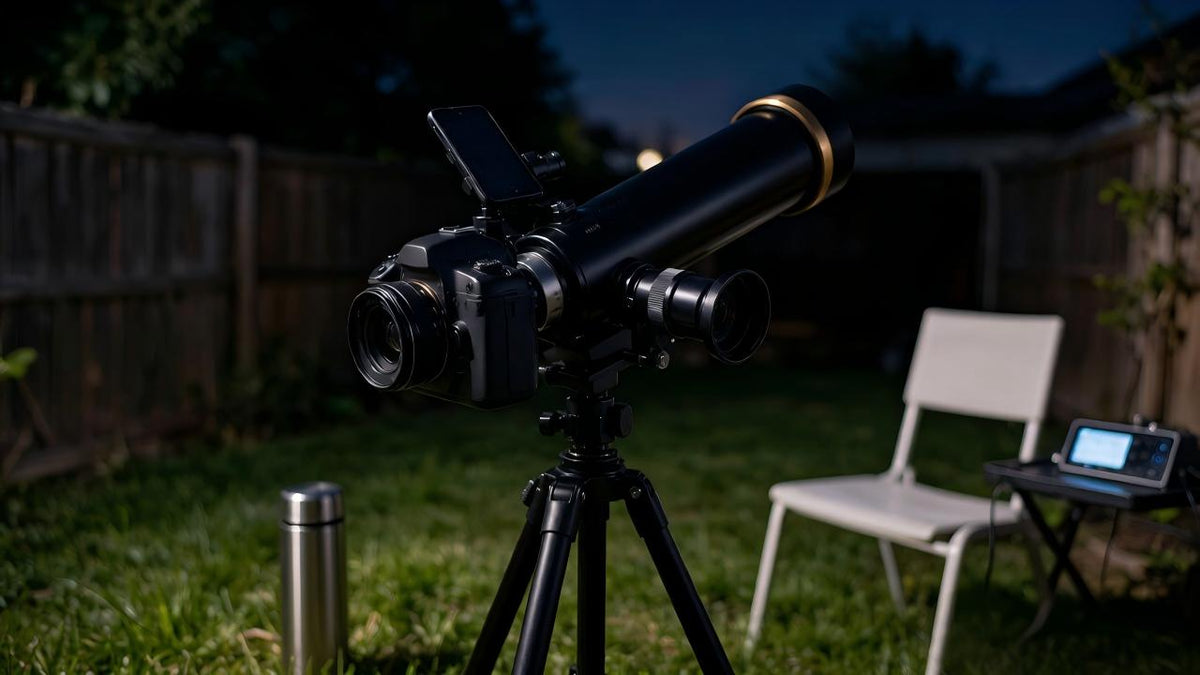
The right beginner camera depends on the target. The Moon, planets, and faint nebulae require different capture methods, and a more expensive camera cannot replace accurate tracking.
| Goal | Practical first camera path |
|---|---|
| Moon | Smartphone adapter or digital eyepiece camera |
| Bright planets | Dedicated planetary camera recording short video |
| Wide Milky Way | Camera or phone with a wide lens on a stable support |
| Faint nebulae and galaxies | Camera plus an accurately tracking mount |
Start With the Moon
The Moon is bright, large, and easy to find. A phone aligned over the eyepiece can record a first image without converting the telescope into a deep-sky imaging system.
Begin at low power, center the Moon, focus visually, attach the phone, and reduce exposure so bright areas retain detail. A remote shutter or timer helps reduce shake.

Digital Eyepiece Cameras
A digital eyepiece camera replaces or fits into the eyepiece position and sends a live image to a phone or computer. It can be useful for the Moon and bright targets, group viewing, and basic recording.
The current Koolpte WiFi telescope eyepiece camera should be presented as a bright-target learning tool, not as a substitute for a cooled deep-sky camera or precision tracking mount.
Planetary Cameras
Dedicated planetary cameras commonly record many short video frames. Software selects and stacks the sharper frames to reduce the effects of atmospheric blur and noise.
This workflow still requires accurate focus, keeping the planet on the sensor, suitable image scale, and processing. A manual mount can make keeping a small planet centered difficult. The aperture and focal-length guide explains the optical terms behind comparing setups.
DSLR and Mirrorless Cameras
A camera body can record the Moon through a suitable telescope connection, but compatibility requires the correct adapter and enough focuser travel. The combined camera weight must also be appropriate for the focuser and mount.
For faint deep-sky targets, long exposures require accurate tracking. Buying a used DSLR does not solve field rotation or tracking error on a simple manual mount.
Wide-Field Milky Way Photography
Do not aim a phone through a beginner telescope to create a wide Milky Way panorama. Use a phone or camera's own wide lens, a stable tripod, dark skies, and an appropriate exposure mode. This is a different workflow from eyepiece photography.
A Sensible Upgrade Order
- Learn visual focus and target finding.
- Capture the Moon with the phone equipment already available.
- Improve alignment and stability before increasing image scale.
- Choose a planetary camera only for a planetary-video workflow.
- Invest in accurate tracking before attempting long-exposure deep-sky imaging.
FAQ
Can I use my phone for astrophotography?
Yes, especially for introductory Moon and bright-target captures through an eyepiece adapter.
Is a DSLR better than a planetary camera?
They serve different workflows. A planetary camera is optimized for high-frame-rate video; a DSLR or mirrorless camera is more flexible for wide-field and larger-sensor imaging.
Do I need a tracking mount?
Not for short Moon captures. Accurate tracking becomes essential as exposures become longer and targets become fainter.
Can a WiFi eyepiece camera photograph galaxies?
Treat it primarily as a Moon and bright-target learning tool unless current documented testing supports a more specific claim.
Share:
Nebula Filters Guide: UHC, O-III, and H-Beta Filters Explained
70mm vs 80mm vs 90mm Telescope: Which Size Should a Beginner Choose?