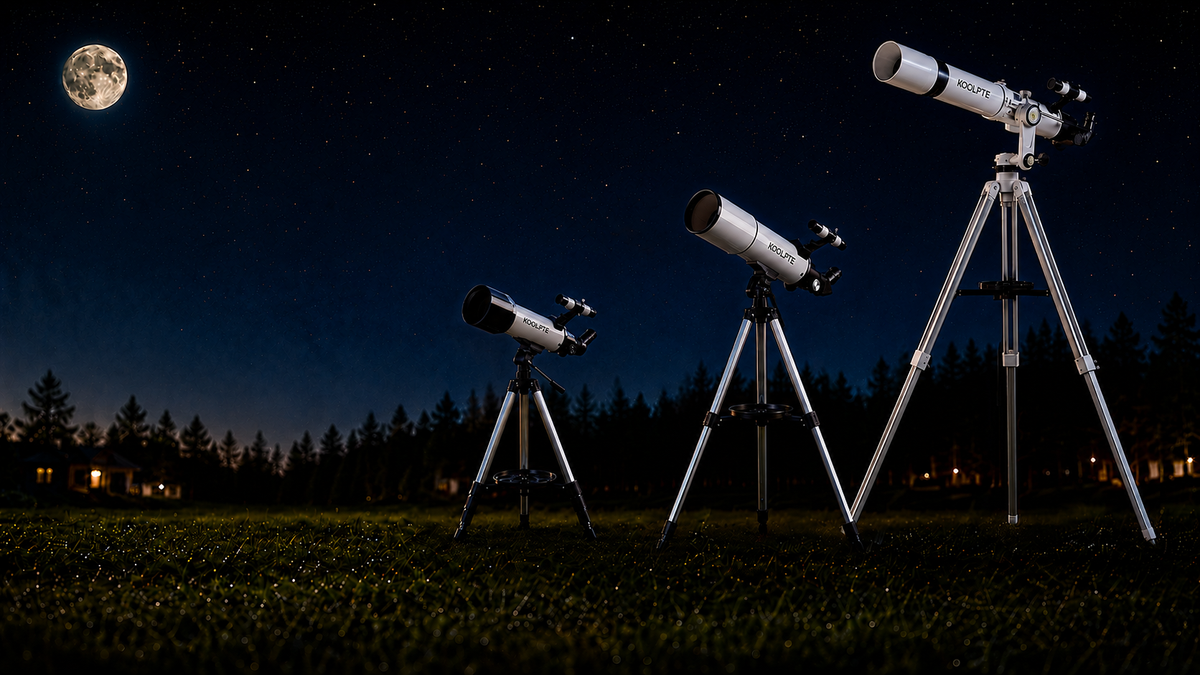
Choosing between a 70mm, 80mm, and 90mm telescope is not simply a matter of buying the largest number. A larger aperture can collect more light and resolve finer detail, but the complete telescope also has to be stable, easy to carry, and simple enough that you will actually use it.
For most beginners, the practical answer is:
| Your priority | A sensible starting point |
|---|---|
| Easy family nights, travel, and compact storage | 70mm |
| A brighter all-around beginner view without moving to a large setup | 80mm |
| Moon and bright-planet detail, with less emphasis on portability | 90mm |
There is no universal winner. The best choice is the telescope that matches where, how, and how often you plan to observe.
What Do 70mm, 80mm, and 90mm Mean?
These numbers describe the diameter of the telescope's front lens, or aperture. Aperture affects two important things:
- how much light the telescope can collect;
- how much fine detail it can theoretically resolve.
Light-gathering area increases with the square of the aperture. Using a 70mm lens as the baseline:
| Aperture | Relative collecting area | Practical meaning |
|---|---|---|
| 70mm | 1.00x | A compact entry point for the Moon, bright planets, and bright star clusters |
| 80mm | About 1.31x | Roughly 31% more collecting area than 70mm |
| 90mm | About 1.65x | Roughly 65% more collecting area than 70mm |
Those percentages are geometry, not a promise that every target will look exactly 31% or 65% brighter. Sky conditions, optical quality, magnification, observer experience, and mount stability all affect the view.
Aperture and Focal Length Are Not the Same Thing
Aperture describes the width of the main lens. Focal length helps determine magnification and field of view with a particular eyepiece.
Magnification is calculated as:
telescope focal length / eyepiece focal length
For example, a 500mm telescope with a 25mm eyepiece produces 20x. A 400mm telescope with the same eyepiece produces 16x.
That does not mean the 500mm telescope has more resolving power when both use a 70mm aperture. It means the same eyepiece produces a somewhat higher magnification and narrower field. This distinction matters when comparing a 70/400 travel-oriented telescope with a 70/500 starter kit.
What Changes at the Eyepiece?
The Moon
All three apertures can provide rewarding views of lunar craters, mountain ranges, and shadows along the terminator. Moving to 80mm or 90mm can make fine detail easier to study when the atmosphere is steady, the telescope is focused, and the mount is stable.
Jupiter and Saturn
A 70mm telescope can show Jupiter's four bright Galilean moons and Saturn's rings under suitable conditions. An 80mm or 90mm aperture can make planetary detail easier to detect, but the planets will still look small. Excessive magnification will not create detail that the atmosphere or optics cannot support. For a target-by-target look at the smallest option, read what a 70mm telescope can actually show.
Star Clusters, Nebulae, and Galaxies
Larger aperture helps with faint objects, but dark skies often matter more than beginners expect. Bright open clusters and the Orion Nebula are useful first targets. The Andromeda Galaxy usually appears as a soft glow rather than a colorful photograph. A move from 70mm to 90mm does not cancel the effects of city light pollution.

70mm Telescope: Best for Easy First Nights
A 70mm refractor is a practical choice when portability, storage, and straightforward setup matter most. It can be especially suitable for families sharing a first telescope or beginners who need to carry the complete kit between home, a backyard, and a campsite.
Two 70mm telescopes can still feel different. The Koolpte Vega Air 70/400 portable beginner telescope favors compact handling and a wider low-power view. The Koolpte Vega Lite 70/500 beginner telescope kit uses the same aperture with a longer focal length, producing more magnification with the same eyepiece.
Choose 70mm if the telescope being easy to bring outside is more important than gaining every possible increment of brightness.

80mm Telescope: A Balanced Step Up
An 80mm aperture provides about 31% more collecting area than a 70mm aperture. That is a useful step up without moving directly to the size of many 90mm kits.
The Koolpte Vega Plus 80/600 refractor telescope fits beginners who want a brighter general-purpose view and are comfortable with a longer setup than a compact 70/400 model.
Choose 80mm if you want one beginner telescope for the Moon, bright planets, clusters, and occasional darker-sky trips, while still placing value on manageable storage and transport.

90mm Telescope: More Aperture, More Setup to Consider
A 90mm aperture provides about 65% more collecting area than a 70mm aperture. Under good conditions, that can help reveal subtler lunar and planetary detail and make bright deep-sky targets easier to observe.
The tradeoff is not the lens alone. A longer tube, heavier tripod, and more substantial mount can require more storage and setup effort.
The Koolpte Vega Precision 90/700 telescope for adult beginners is the more general-purpose 90mm path. The Vega Precision Ultra 90/900 for Moon and planet viewing uses a longer focal length for observers who place more emphasis on lunar and planetary viewing.
Choose 90mm when better detail is worth carrying and storing a larger complete setup.
Which Size Is Best for Kids and Families?
Start with ease of use, not the child's age alone. A compact 70mm telescope can be the better family choice when an adult will help aim and focus it and the setup needs to move easily. An 80mm can make sense for an older beginner who is likely to use the telescope regularly.
A larger aperture is not automatically more child-friendly. A shaky or difficult setup can be more frustrating than a smaller telescope that reaches the Moon quickly.
Which Size Is Best for an Adult Beginner?
An adult observing mostly from a backyard may appreciate an 80mm or 90mm telescope. Someone who must carry the telescope down stairs, fit it into a small car, or store it in an apartment may use a 70mm much more often.
Ask one practical question before buying: will you comfortably move the entire telescope, tripod, eyepieces, and bag to your observing location?
Final Recommendation
- Choose 70mm for portability, family use, compact storage, and low-pressure first nights.
- Choose 80mm for a balanced increase in light collection without immediately moving to the largest beginner setup.
- Choose 90mm when lunar and bright-planet detail matters more than minimum size and weight.
If you are still comparing individual models, browse Koolpte beginner telescopes by complete setup and intended use rather than by aperture alone.
FAQ
Is an 80mm telescope better than a 70mm telescope?
An 80mm aperture has about 31% more collecting area than a 70mm aperture, but "better" also depends on portability, mount stability, focal length, and how often the telescope will be used.
Is a 90mm telescope good for beginners?
Yes, when the beginner is comfortable with the complete setup's size and handling. A stable 90mm refractor can be a useful Moon and bright-planet telescope, but a compact 70mm may be used more often by someone with limited storage or transport.
Can a 70mm telescope show Saturn's rings?
Yes. Saturn's rings are within reach of a 70mm telescope under suitable conditions, although the planet will appear small. Good focus, a stable mount, and steady air matter more than chasing the highest advertised magnification.
Does a 90mm telescope show 65% more detail than a 70mm telescope?
No. The 65% figure describes relative lens area, not a direct percentage increase in visible detail. Resolution, contrast, sky conditions, magnification, and optical quality all affect what you can detect.
Share:
Beginner Astrophotography Cameras: Start With the Target, Not the Camera