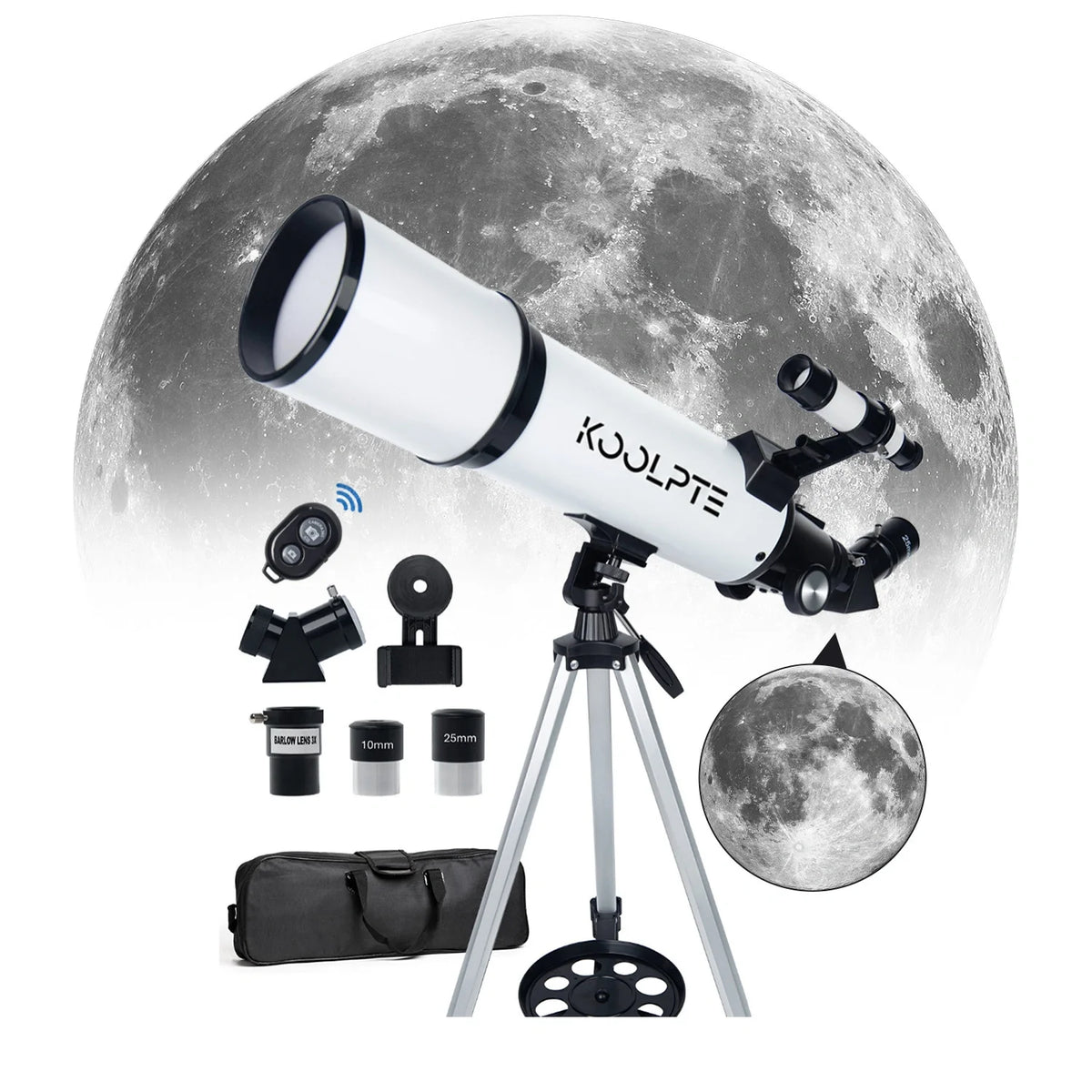
A telescope under $200 can provide a successful first view of the Moon and bright planets, but price alone does not separate a useful beginner telescope from a frustrating one. Start with a real aperture specification, a manageable complete setup, and a mount that lets you focus without fighting constant vibration.
This guide uses current Koolpte products that were listed below $200 on September 21, 2026. Prices and stock can change, so confirm the displayed product-page price before buying.
Quick Comparison: Current Telescopes Under $200
| Model | Aperture / focal length | Price checked | Best fit |
|---|---|---|---|
| Vega Air 70/400 | 70mm / 400mm | $54.99 | Compact family and travel setup |
| Vega Lite 70/500 | 70mm / 500mm | $59.99 | First Moon and bright-planet telescope |
| Vega Plus 80/600 | 80mm / 600mm | $99.99 | Balanced step up in aperture |
| Vega Precision 90/700 | 90mm / 700mm | $139.99 | Adult beginner prioritizing the Moon and planets |
Price check: September 21, 2026, USD, standard displayed product prices. Promotions, taxes, shipping, and later price changes are not included.
What Matters More Than Advertised Magnification
- Aperture: the diameter of the main lens or mirror. It affects light-gathering area and theoretical resolution.
- Mount behavior: the image should settle quickly after focusing. Judge the complete setup rather than relying on a mount label alone.
- A low-power starting view: lower magnification makes targets easier to find and center.
- An alignable finder: a finder that points where the telescope points saves a great deal of beginner frustration.
- Clear product and return information: check what is included, current stock, support, and return terms on the live product page.
Extreme magnification claims are a poor buying guide. Useful power changes with aperture, optical quality, focus, atmospheric steadiness, and mount stability.
What Can You Realistically See?
A suitable beginner telescope can show detailed lunar terrain, Jupiter's bright Galilean moons, Venus's phases, and Saturn's rings when the planet's presentation and observing conditions cooperate. Mars usually remains a small orange disk, with markings most favorable near opposition and during steady air.
Under darker skies, bright open clusters, the Orion Nebula, and the Andromeda Galaxy are possible targets. Expect most nebulae and galaxies to look faint and gray rather than like processed photographs.
For a fuller expectation check, read what you can actually see with a 70mm telescope.
Choose by Use, Not by a Ranking
Compact family or travel use: 70/400

The Vega Air 70/400 is the practical path when storage, transport, and a wide low-power view matter most. Its short focal length does not make it automatically better or worse; it changes the magnification produced by a given eyepiece.
A first Moon and planet telescope: 70/500

The Vega Lite 70/500 provides slightly more magnification than a 400mm telescope when both use the same eyepiece. It remains a 70mm telescope, so steady setup and realistic expectations matter more than chasing maximum power.
A balanced aperture step up: 80/600

The Vega Plus 80/600 has about 31% more lens area than a 70mm aperture. That is a theoretical area comparison, not a promise that every target will look 31% brighter at the eyepiece.
More aperture for an adult beginner: 90/700

The Vega Precision 90/700 has about 65% more lens area than a 70mm aperture. Consider the complete setup's size and handling as well as the optical tube.
The 90/900 model is not included because its current displayed price was $209.99 at the time of this check. A temporary discount should be verified on the product page before treating any model as an under-$200 choice.
What to Avoid
- Buying mainly because the box advertises extreme magnification.
- Assuming a long accessory list guarantees a stable or comfortable observing experience.
- Expecting colorful deep-sky photographs at the eyepiece.
- Spending the full budget on extra eyepieces before learning the included low- and medium-power options.
- Choosing a larger setup that is too awkward to carry, store, or use regularly.
Before You Buy
- Confirm the current price is still below $200 without relying on an unavailable future promotion.
- Check the product page for current stock, included accessories, and variant details.
- Decide where the complete telescope will be stored and used.
- Choose the smallest setup you will actually take outside, not simply the largest aperture that fits the budget.
The 70mm vs 80mm vs 90mm telescope comparison explains the optical and handling tradeoffs in more detail. You can also view the current Koolpte telescope collection to recheck price and availability.
FAQ
Can a telescope under $200 show Saturn?
Yes. A suitable small telescope can show Saturn's rings under good conditions, although the planet remains small and ring presentation changes over time.
Is 70mm enough for a beginner?
Yes, especially when portability and easy setup matter. A 70mm refractor can provide rewarding views of the Moon, bright planets, and selected bright deep-sky objects.
Is a 90mm telescope always the better choice?
No. It offers more aperture, but the complete setup may be larger. A compact telescope used frequently is more valuable than a larger one left indoors.
Should I buy used?
A well-maintained used telescope can offer good value. Inspect the optics, focuser, mount, missing accessories, and return options before purchase.
Share:
Refractor Telescope Guide for Beginners
Smart Telescope vs Traditional Telescope: Which Experience Fits You?