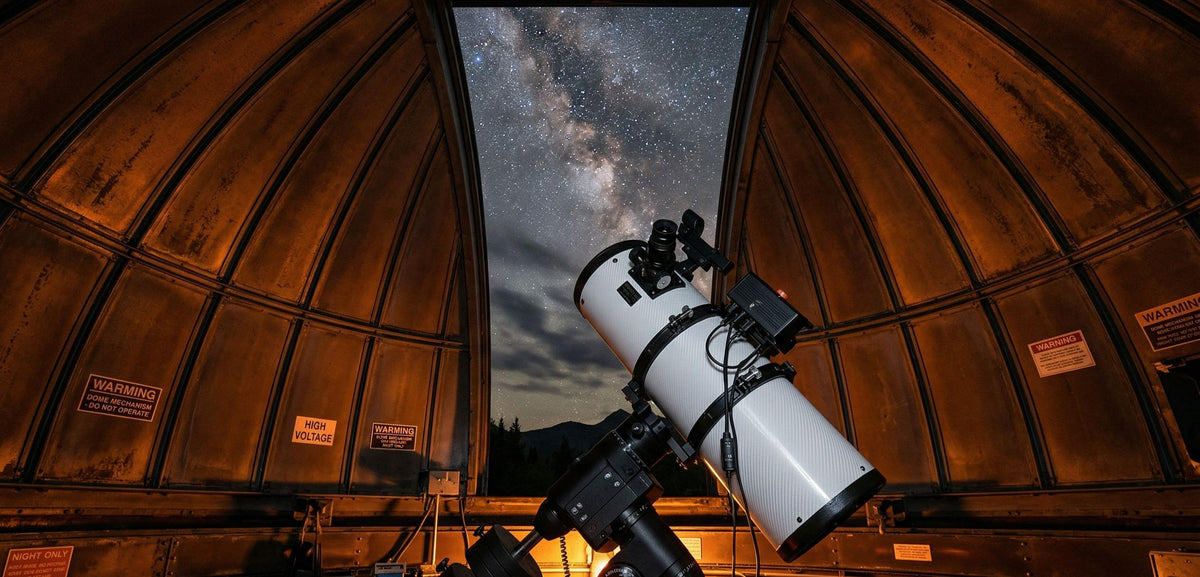
A refractor uses a lens at the front of the tube to collect and focus light. Small refractors are popular first telescopes because they are straightforward, usually require little optical alignment, and can be used for both astronomy and distant daytime viewing.
They are not automatically the best choice for every beginner. Reflectors often provide more aperture for the budget, while compound telescopes can package a long focal length into a shorter tube.
Why Beginners Choose Refractors
- The main lens is fixed in a closed tube and normally does not require user collimation.
- Small models can be carried and stored easily.
- The eyepiece is at the rear, which can be comfortable for many daytime and sky targets.
- They work well for the Moon, bright planets, open clusters, and terrestrial viewing.
The mount still matters. A useful optical tube on a shaky tripod will be difficult to focus and track.
Achromat, ED, and Apochromat
Most budget refractors are achromats. They bring two regions of the visible spectrum closer to the same focus, but bright objects may show a violet fringe, especially in short-focal-ratio models.
ED and apochromatic refractors use more specialized glass and optical designs to reduce false color. Those labels do not guarantee perfect performance; manufacturing quality, design, aperture, and focal ratio still matter.
Aperture and Focal Length
Aperture controls collecting area and theoretical resolution. Focal length, together with the eyepiece, determines magnification:
telescope focal length / eyepiece focal length
A 70/400 and 70/500 share the same aperture. With the same eyepiece, the 70/400 provides lower magnification and a wider field; the 70/500 provides higher magnification and a narrower field. The longer focal length does not increase the 70mm aperture's theoretical resolution.


Choosing a Current Koolpte Refractor
| Model | Practical role |
|---|---|
| Vega Air 70/400 | Compact family, travel, and easy low-power finding |
| Vega Lite 70/500 | Longer-focal-length 70mm starter kit |
| Vega Plus 80/600 | Balanced aperture step up |
| Vega Precision 90/700 | Adult beginner and general backyard use |
| Vega Precision Ultra 90/900 | Longer-focal-length Moon and planet emphasis |
Choose by the complete setup, not the tube alone. Consider storage, tripod, observing height, accessories, and the distance to your observing location.
What Can a Beginner Refractor Show?
A properly focused 70mm to 90mm refractor can provide rewarding views of lunar terrain, Jupiter's bright moons, Saturn's rings, Venus's phases, bright star clusters, and selected nebulae. Larger aperture can make subtle detail easier, but sky conditions and mount stability remain important.
Deep-sky objects generally appear gray and faint compared with processed photographs. City light pollution cannot be solved simply by increasing magnification.
First-Night Method
- Align the finder during the day on a distant stationary object.
- Begin with the longest-focal-length eyepiece.
- Center and focus the Moon or another bright target.
- Let vibration settle after touching the focuser.
- Increase magnification only when the image remains clear.
Do not attempt to collimate the main lens of a normal beginner refractor. If the view is poor, first check focus, diagonal seating, eyepiece placement, finder alignment, lens caps, and atmospheric conditions.
Who Should Choose a Refractor?
Choose a refractor when low routine maintenance, family use, portability, or daytime viewing matters. Consider a reflector when maximum aperture for the budget matters more and you are willing to learn collimation.
The refractor vs reflector vs Cassegrain guide covers that decision. The 70mm vs 80mm vs 90mm comparison covers aperture choices within the refractor lineup.
FAQ
Is a refractor good for beginners?
Yes. Small refractors are straightforward and normally require little optical alignment, but mount stability and usable aperture still matter.
Do refractors need collimation?
Typical beginner refractors do not require routine user collimation of the main lens.
Why do I see a purple edge around the Moon?
An achromatic refractor can show chromatic aberration around bright targets. It is more noticeable in some short-focal-ratio designs and at higher magnification.
Is 70mm or 90mm better?
The 90mm aperture has more collecting area, while a 70mm setup may be easier to carry and use. The better choice depends on the complete setup and observing priorities.
Share:
Best Beginner Telescope in 2026: Complete Buying Guide
Best Telescope Under $200: How to Choose Without Buying a Toy